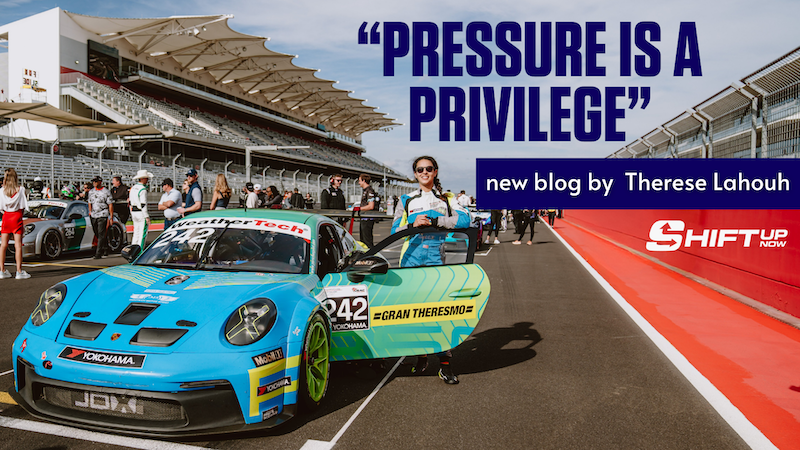
Written by Therese Lahlouh
I was 32 years old the first time I took a green flag.
I had always loved cars, and going fast. But I didn’t think professional racing was something ordinary people could do. Racecar drivers, in my mind, were born into it. They were karting prodigies, generational talents, kids trained from childhood for a life behind the wheel.
Then, in 2017, some friends invited me to a track day.
That was the first time I learned that regular people could drive on a racetrack. I learned about HPDE, time trials, autocross—grassroots entry points into motorsport that I had no idea existed. When the day ended, I didn’t feel satisfied. I felt hungry. My competitive nature kicked in, and I wanted to beat the people who went faster than me.
After competing in a few time trial events, my coach Nik Romano casually suggested I enter a local Miata league. Wheel-to-wheel racing had never crossed my mind. My immediate reaction was worry that I wasn’t qualified. But I trusted him when he said I was ready. I rented a car, signed up for a race, and in 2021, at 32 years old, I entered my first club race in a Super Miata.
From the first green flag, I was hooked.
Pouring into turn 1 with 30 cars was one of the most exhilarating moments of life. All I wanted was to get better at it. Racing offered the challenge I craved: car control, racecraft, psychology, risk management, emotional management. And the paddock welcomed me in.
I never stopped to think about being a woman, I never paused to question whether I belonged. I was simply another driver trying to learn. I threw myself in headfirst. I studied data, asked questions, made mistakes. I absorbed everything.
Six months later, I stood on my first podium. Six months after that, I earned my first win and Rookie of the Year. It was the first female win in the series’ 10-year history. That was the moment I realized something bigger was happening. I was inspiring people.
Women in the paddock started telling me that watching me succeed made them feel like they could try too. The men I passed for the win were applauding loudest, proud of the rookie, not mad a woman beat them. Representation stopped being theoretical. It was real.
By 2023, I was on the podium nearly every weekend. In the NASA SoCal paddock, something shifted. A woman wasn’t just participating, or even just doing well, she was expected to win. I realized in that moment that I could have a real impact.
Around that time, my close friend JJ Chen said something that changed my trajectory: “I want to see how far you can go.”
I confessed a secret dream I’d never told anyone: I wanted to race at Le Mans. He didn’t laugh. He didn’t dismiss it as unrealistic. He told me about Porsche Sprint Challenge and the Porsche ladder system, and suggested I try GT4 in a Cayman.
I struggled to find teams willing to return my calls. I didn’t grow up in motorsport. I didn’t have connections. I was taken advantage of, harassed, and embarrassed. Multiple contracts fell through, the last one days before the first race. I almost gave up, thinking that maybe it just wasn’t meant for me.
Finally, I found a local team running Porsche Sprint Challenge USA West that would be happy to have me—in GT3 Cup. It was a massive jump from a Miata on DOT tires to a Porsche 992 GT3 Cup Car on 325 slicks. I ran a partial season with no testing, and finished sixth overall despite missing races. I knew then this wasn’t a hobby anymore. If I wanted to chase something as ambitious as Le Mans, I needed to treat it like a profession.
I walked away from my career in hospitality, and committed everything I had to racing. With Madeline Stewart’s recommendation, I found a home at JDX for Porsche Sprint Challenge North America. Jeremy Dale asked me about my goals, and I told him I wanted to race WEC. He didn’t laugh either. He told me it would take a lot of work, and that I would need to change how I approached racing.
Coming from grassroots racing, I had never learned how professional drivers communicate with engineers. Jeremy sat me down and taught me how to write proper driver reports, how to articulate feedback, how to comport myself in a professional environment. He let me be myself, but helped mold me into a sharper version.
What I didn’t know was that he recommended me for the Porsche Mobil 1 Female Driver Program. I found out at Sebring in 2024. It felt surreal. In just a few years, I had gone from someone who didn’t know regular people could race cars to being selected for a development program backed by one of the most iconic manufacturers in the world.
That’s when the message crystallized: your life isn’t over at 30. Your dreams aren’t dead. If you are willing to invest in yourself and risk everything you have, your time, your money, your ego, your comfort, you can achieve the extraordinary. But growth isn’t immediate, nor is it linear.
At the start of 2025, I began working more closely with Thomas Merrill. I thought I was ready for Carrera Cup. Instead, an opportunity arose to host the series after I performed well in the booth and on air interviews. I chose to stay in Sprint Challenge another year to build visibility and develop further.
Outwardly, it made sense. Inwardly, I was frustrated. I felt like time was slipping through my fingers. Young Silver drivers would often disappear up the road, and I found myself measuring my worth against theirs. Thomas helped me reframe that thinking. As a Bronze driver, my benchmark was not the young professionals with decades of karting behind them. My competition was the other Bronzes. Once I accepted that, I realized I was already much closer to the front than I had allowed myself to believe. I was not behind. I was building.
That mental shift helped me feel like I deserved to be out there. I was good enough. Now it was about maximizing potential.
I had to sharpen the feedback loop between myself and the engineers. I have a strong feel for the car, but no formal engineering or physics background. I had to learn the language to translate feel into actionable data for the team. Ironically, I discovered that I drive best when I’m focused on delivering precise feedback. Pushing the car to its limit gives me the clearest information.
Somewhere along the way, I developed a fear of mistakes.
Early in my career, I didn’t care if I went off track or crashed the car. I was learning, and it felt like something to be expected. But as the machinery became more expensive and the stakes higher—especially under the spotlight of the Female Driver Program—I became afraid of getting it wrong.
I’m working to return to that earlier mindset: it’s okay, I’m learning.
Preparing for GT3 meant confronting new challenges, especially aerodynamics. Mechanical grip is intuitive. Aero requires trust. Often you cannot feel it in the same tangible way. You must believe in the downforce and commit. For someone who identifies as a “feel” driver, that was difficult.
To explore aero and my options, I tested prototypes, an LMP3 and an LMP2. I fell in love with the LMP3. The LMP2 was so much car for someone at my experience level, and while I loved it, it felt like it would take years to be able to race one. That put us back in GT3 world.
Samantha Tan generously let me test her BMW M4 GT3. It was approachable, capable, and comfortable, but I missed the raw brutality of the Cup Car. When I tested the Wright Motorsports Porsche GT3 R at Road America, I felt at home. That test clarified it: GT3 was the path.
After evaluating budgets and series, SRO GT World Challenge America made sense. In this format, the Bronze driver qualifies the car and drives at least half the race. That means I can maximize my development in GT3 equipment before transitioning to a series like WEC where there is less seat time for the Bronze.
Thomas and I ran the Apex One 10-hour at Sebring last November with Wright Motorsports and won our class, finishing second overall. That race reminded me that I’m well suited to endurance racing. In sprint racing, it’s just you—the pressure, the glory, the embarrassment, it’s all yours. In endurance racing, every pit stop, every driver change, every tenth of a second in pit lane matters.
A small fumble can undo hours of work. Strangely, that shared responsibility quiets the demons in my head. I’m a consistent, methodical driver. I focus on hitting marks, executing procedures, doing my job. In doing so, I feel less pressure because it’s not all on me, I’m just a part of the team.
Still, stepping into GT3 comes with weight. This is the largest investment I’ve ever made in myself. We get more risk averse as we get older, and it feels harder and harder to take these leaps of faith.
I’ve had to redefine pressure.
For years, I’ve seen pressure as an obstacle to overcome, a menacing evil force hellbent on thwarting my best efforts. Now I see it differently: pressure is a privilege. I worked hard to be in a position where expectations exist. That means I’m progressing.
In my professional life outside racing, I spent 20 years building competence in one of the highest-pressure environments imaginable, a three Michelin-star restaurant. I didn’t thrive there on day one. It took years of discipline and repetition. Racing is no different.
Goals are not the same as expectations. Goals are intentional. Expectations can be punishing. I’m learning to set clear, achievable goals, and to be proud of my progress.
If I could speak to my younger self, or to anyone who believes they’ve missed their window, I would say this:
You are not behind.
You are not too old.
You are not disqualified by inexperience.
You followed your curiosity.
You invested in yourself.
You took that green flag at 32 years old and built a racing career from scratch.
You are a real racecar driver.
And you’re just getting started.