Written by Sally Mott
The 2026 season has been unlike any other in my racing career.
I grew up racing on road courses, starting in go-karts before moving into sports cars and the Mazda MX-5 Cup. Oval racing wasn't something I started at a young age. So you’d think that only turning left instead of both directions would make things easier, right? Wrong.
Adding short track racing to my portfolio has shown me that it's an entirely different world. The expectations, culture, race craft, and the way you maximize a lap are completely different.
Learning how to put a late model on the ragged edge has definitely been a challenge, but it’s also something I've really enjoyed. I love figuring out what makes a fast lap in a new type of race car.
Starting in late models with the goal of working my way through regional racing, the CARS Tour, ARCA, Trucks, the Xfinity Series, and eventually the Cup Series almost feels like starting over.
At the same time, I know I'm not actually starting from scratch. I'm coming into this world with years of racing experience and already know what a car feels like on the limit. The challenge isn't learning how to drive fast, it's learning how to apply what I already know to a completely different type of race car. In a lot of ways, I'm having to unlearn techniques that I’ve spent my entire career developing.
One of the biggest examples is how the car rotates. For example, in a sports car, rotation happens as you come off the brake pedal. You brake into the corner, release the brake, the car rotates, and then you pick up the throttle.
A late model works in almost the opposite way. Late models use bump stops, which was a completely new concept to me. As the suspension compresses entering the corner, it reaches the bump stop, dramatically increasing the spring rate. That changes how the car rotates, meaning you actually create a lot of the rotation while you’re still on the brake pedal.
Everything I've spent years refining had to be reprogrammed because what my instincts wanted to do wasn't always what made the car go faster.
Qualifying has also been one of the biggest adjustments. In a late model, the car is taped up to maximize aerodynamic efficiency, and you essentially get one chance to make it happen. You get an out lap, the green flag drops, and then you have two laps to put together your fastest time. That gives you maybe one or two corners to get heat into a fresh set of tires before it’s go time.
Compare that to a road course, where your out lap might include 16 to 22 corners before you even begin your qualifying lap. That's roughly 90 seconds to feel the grip, scrub the tires, and understand what the car is doing, compared to maybe nine seconds on a short track.
Learning how to be at 100% the moment the green flag drops has probably been one of the hardest adjustments for me.
Race craft is completely different, too. In road racing, contact usually comes with consequences. If you move someone out of the way or damage another car while attempting a pass, there's a good chance you'll receive a penalty that ruins your race.
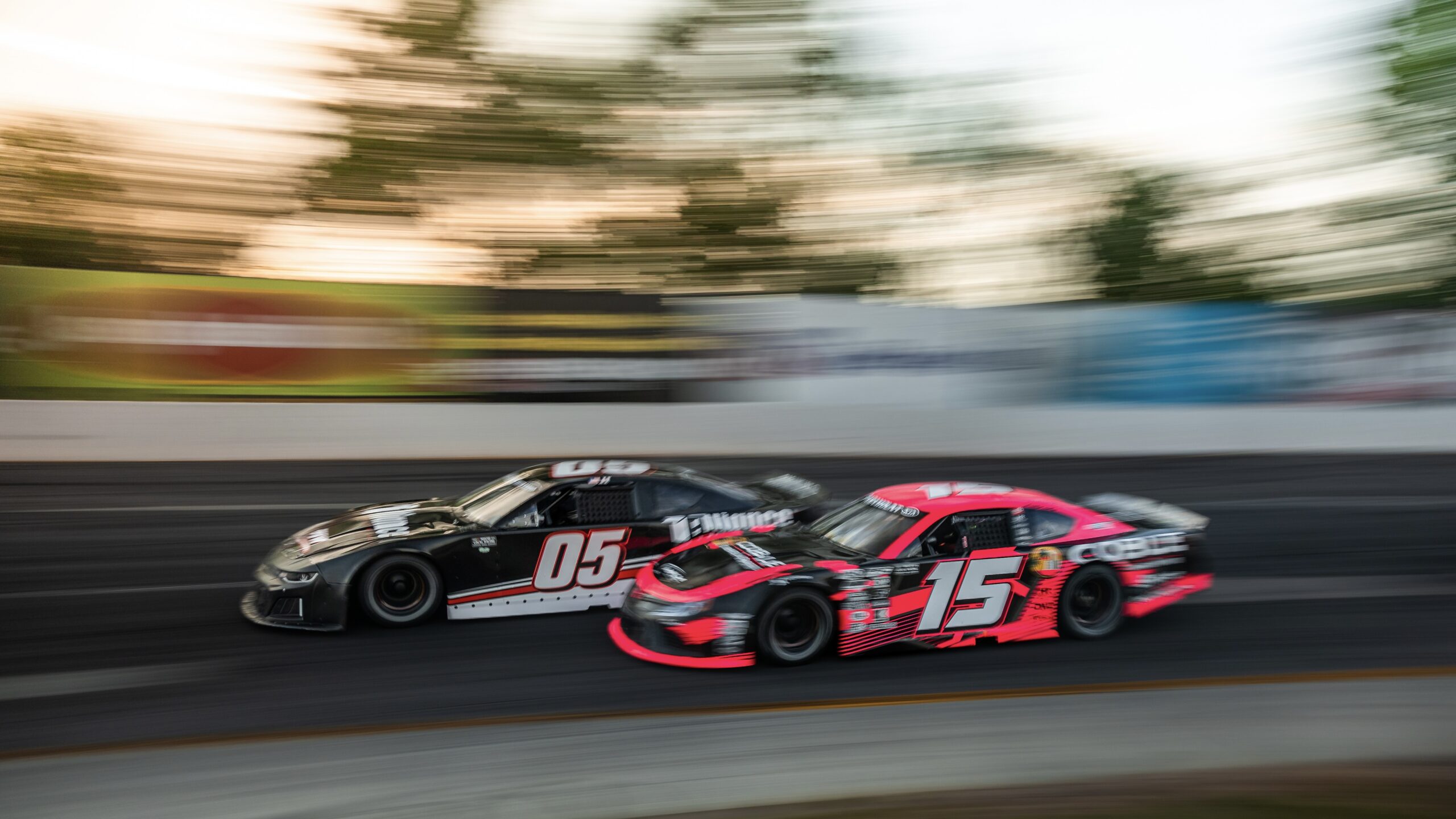
On a short track, rubbing is just part of racing. Drivers lean on each other, move each other out of the way, and race inches apart lap after lap. Unless something is obviously intentional, it’s generally considered fair game, even if someone ends up with a wrinkled fender or in the wall. That mentality definitely took some getting used to.
The pace of a race was another thing I didn't fully understand until I experienced it. A typical late model race might be 40 to 75 straight laps with lap times around 14 to 16 seconds. There aren’t long straightaways like Road Atlanta where you can take a deep breath, collect your thoughts, and prepare for the next braking zone. It's just constant.
Every lap you're processing brake pressure, steering input, throttle application, changing grip levels, traffic, and what the drivers around you are doing. If your mind wanders for even a second, you make a mistake.
The groove changes throughout the race as rubber gets laid down and track conditions evolve. You're constantly adapting, searching for grip, watching what the fastest cars are doing, and trying to stay one step ahead. What surprised me most was how mentally exhausting that is.
Early in the season I'd climb out of the car feeling completely drained because my brain had basically turned into a computer: brake, rotate, roll, apex, throttle, repeat. Sometimes the order changes depending on the track, but your brain never really gets a break. If there's no caution, you stay completely locked in for 20 minutes straight because there simply isn't time to think about anything else if you want to be competitive.
Another adjustment I never expected was learning to trust a spotter. In road racing, I've always relied on my mirrors and my own awareness. You generally have enough time to check your surroundings before making a move.
In a late model, that luxury doesn't really exist. You’re trying to maximize corner speed while racing inches from other cars, so when your spotter says "inside," "clear," or "go high," you don't have time to second guess it. You just have to trust them. Sometimes you don't even have time to process what they said, you just have to react.
Learning that level of trust has probably been one of the biggest mental adjustments for me because your spotter really does become your second set of eyes.
Passing is also much more strategic than I expected. Because it's so difficult to complete a pass on a short track, you usually spend several laps setting one up. You're constantly thinking about where you're stronger than the driver ahead, where they're vulnerable, how to pressure them into making a mistake, and how to make the pass stick once the opportunity comes.
People often call road racing high-speed chess, and I still think that's true, but after this season I honestly think short track racing might be even more of a chess match.
One final difference that surprised me was the race weekend itself. An IMSA weekend usually spans three days with practice, qualifying, and the race spread out over the weekend. Short track racing is completely different. Everything happens in one day.
I usually get to the track around 1:00 p.m. and don't leave until nearly 11:00 p.m. Practice, qualifying, setup changes, racing, everything happens within a matter of hours. It's a completely different environment and culture than what I grew up in, and I've really enjoyed learning how this side of the sport operates.
Every race weekend teaches me something new. The learning curve has definitely been steep, but every lap is making me a better race car driver. I'm adding more tools to my arsenal, expanding my race craft, and becoming a more complete driver as I continue pursuing the NASCAR pathway.